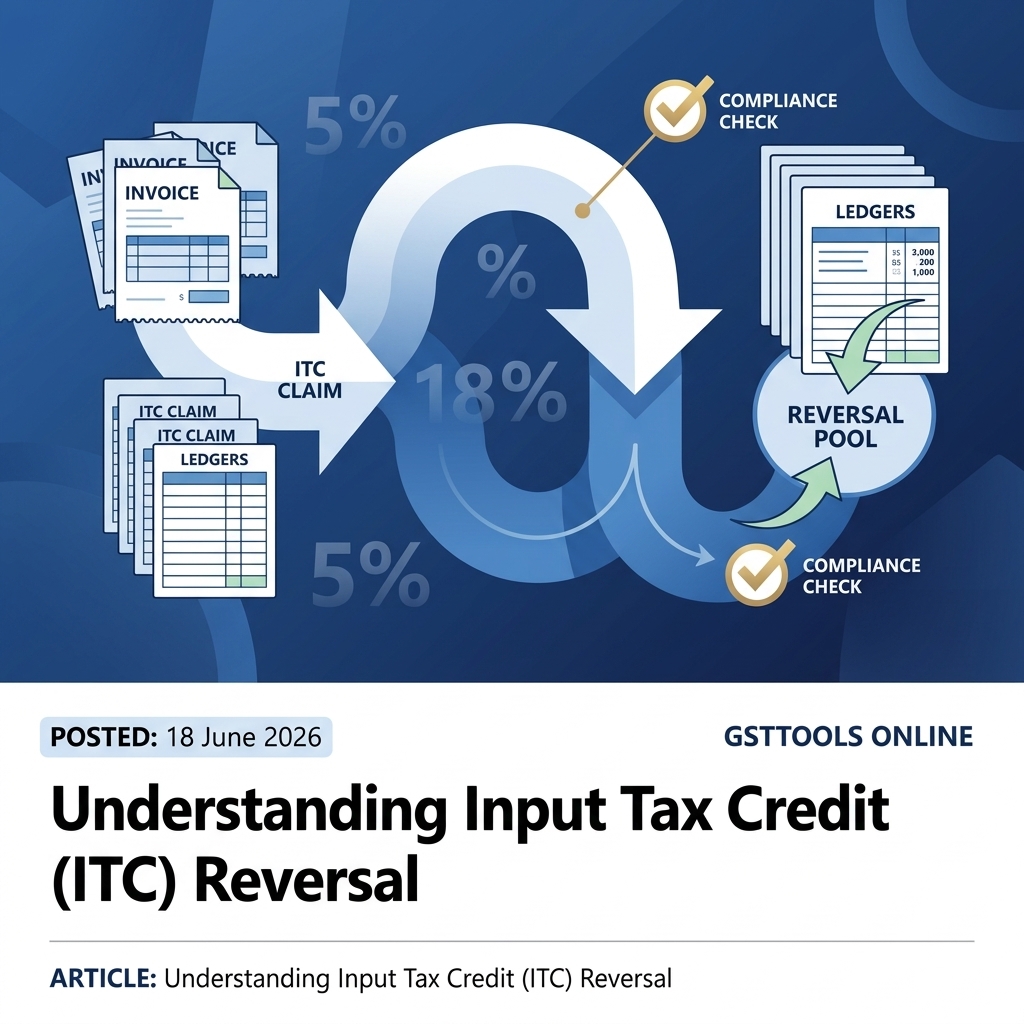
The implementation of GST 2.0 in September 2025 brought sweeping changes to the Indian tax landscape. Thousands of products were reclassified, with many moving from the older 12% and 18% slabs down to the new 5% essential tier. While consumers celebrated the price drops, businesses were left grappling with a complex accounting conundrum: Input Tax Credit (ITC) Reversal.
If you manufactured or purchased goods when the raw materials and finished products were taxed at 18%, you legally claimed ITC at 18%. But now, under the new GST 2.0 regime, you are forced to sell that exact same stock at a 5% GST rate.
This creates an inverted duty structure on the existing stock. The burning question that has flooded CA firms and GST helpdesks is this: Since the output tax rate has dropped, does the government require you to reverse the excess ITC you claimed when the rate was higher?
In this comprehensive, 1500-word guide, we will dissect the legal provisions of the CGST Act, analyze the concept of ITC accumulation, and provide a definitive answer on whether an ITC reversal is actually required when GST rates drop.
The Core Concept of Input Tax Credit (ITC)
To understand the reversal rules, we must first revisit the fundamental premise of ITC. The Goods and Services Tax is a value-added tax. You pay tax on your inputs (purchases), collect tax on your outputs (sales), and remit only the difference to the government.
Section 16 of the CGST Act, 2017 outlines the basic conditions for claiming ITC:
- You must possess a valid tax invoice.
- You must have received the goods or services.
- The supplier must have paid the tax to the government.
- You must have filed your GST returns.
If you fulfilled all these conditions at the time of purchasing your raw materials or trading stock, the ITC legally vested in your electronic credit ledger. It became your absolute property, akin to cash sitting in a digital wallet.
The Myth of “Excess” ITC Reversal
When the GST rate on a finished product drops from 18% to 5%, but the inputs were purchased at 18%, the business will accumulate ITC. For example:
- Input Purchase: ₹100 + ₹18 (GST) = ₹118. (You claim ₹18 as ITC).
- Output Sale (After Rate Drop): ₹150 + ₹7.50 (5% GST) = ₹157.50.
- Tax Liability: You owe the government ₹7.50. You pay this using your ₹18 ITC balance.
- Remaining ITC: You still have ₹10.50 sitting in your credit ledger.
Many aggressive tax officers and overly cautious accountants argue that this ₹10.50 is an “unjustified” benefit and must be reversed. This is a myth.
What the Law Actually Says
There is no provision in the CGST Act or Rules that mandates the reversal of legitimately claimed ITC simply because the output tax rate was subsequently reduced by the government.
Section 17(5) of the CGST Act lists the specific scenarios where ITC is blocked (e.g., motor vehicles, food and beverages, goods given as free samples). Section 17(2) and Rule 42/43 mandate reversal only when goods are used for non-business purposes or for making exempt supplies.
Crucially, a supply taxable at 5% is a taxable supply, not an exempt supply. Therefore, the provisions of Rule 42 (which require reversal for exempt supplies) absolutely do not apply when the tax rate merely drops to a lower percentage.
When DO You Actually Need to Reverse ITC?
While a rate drop to a lower taxable slab does not trigger a reversal, you do need to reverse ITC in specific scenarios that are often confused with a rate drop. You must use an ITC Reversal Checker to ensure accuracy if you fall into these categories:
1. The Product Becomes Wholly Exempt (Nil Rated)
If the GST Council decides to drop the tax rate on your product to 0% (making it wholly exempt), the situation changes drastically. Under Section 18(4) of the CGST Act, if a taxable supply becomes wholly exempt, the registered person shall pay an amount equal to the ITC in respect of:
- Inputs held in stock.
- Inputs contained in semi-finished or finished goods held in stock.
- Capital goods (reduced by percentage points) on the day immediately preceding the date of exemption.
If your product moves from 12% to Exempt, YES, you must reverse the ITC on the stock lying in your warehouse.
2. Shifting to the Composition Scheme
If a rate change prompts you to opt into the Composition Scheme (where you pay a flat 1% to 6% on turnover but cannot claim ITC), you must reverse the ITC on all existing stock on the date of transition, as per Section 18(4).
3. Goods Destroyed, Lost, or Given as Samples
If the rate drop makes your older stock unsellable, and you decide to write it off, destroy it, or give it away as free promotional samples to clear warehouse space, Section 17(5)(h) triggers immediately. You must reverse the ITC on those specific goods.
Dealing with the Accumulated ITC
If you don’t have to reverse the ITC, what happens to the massive credit balance accumulating in your electronic ledger? This is the phenomenon known as an Inverted Duty Structure.
An inverted duty structure occurs when the rate of tax on inputs is higher than the rate of tax on outward supplies. In our earlier example, inputs were at 18%, and outputs were at 5%.
The Refund Mechanism
The government recognizes this cash flow blockage. Under Section 54(3) of the CGST Act, taxpayers facing an inverted duty structure can apply for a cash refund of the unutilized input tax credit.
However, there are caveats:
- Input Services Excluded: The Supreme Court of India has upheld that the refund under the inverted duty structure is only available for the ITC accumulated on Inputs (Goods). You cannot claim a refund for the ITC accumulated on Input Services (e.g., rent, software, advertising) or Capital Goods (machinery).
- The Formula: The maximum refund amount is determined by a strict formula outlined in Rule 89(5) of the CGST Rules. You must apply this formula rigorously before filing Form GST RFD-01.
Strategic Adjustments
If you do not want to go through the bureaucratic hassle of filing for a refund, the unutilized ITC never expires. You can carry it forward indefinitely and use it to offset output tax liabilities on other products you sell that might have higher tax rates.
For instance, if a retailer sells both 5% food items and 18% electronics, the accumulated ITC from the food business can legally be utilized to pay the output tax liability of the electronics business, provided they are under the same GSTIN.
Handling Departmental Notices
Despite the clarity of the law, it is not uncommon for businesses to receive automated scrutiny notices (ASMT-10) from the GST department pointing out a mismatch between the high ITC claimed and the low output tax paid.
When a desk officer sees that you claimed ₹10 Lakhs in ITC but only paid ₹3 Lakhs in output tax during the quarter the rates dropped, their algorithms flag it as potential tax evasion.
How to Respond:
- Do not panic and do not reverse the ITC voluntarily. Reversing ITC and paying it with interest just to close a notice is a massive financial loss.
- Draft a Legal Reply: Respond to the ASMT-10 stating that the variance is purely due to the GST Council’s rate rationalization effective [Date].
- Cite the Law: Explicitly state that under Section 16, the ITC was validly claimed, and since the outward supply remains taxable (albeit at a lower rate), Section 17(2) and Rule 42 are not applicable.
- Provide a Stock Reconciliation: Attach a simple reconciliation statement showing the stock held on the date of the rate change, proving that the ITC corresponds to the high-tax inputs sitting in inventory.
Conclusion
To definitively answer the question: No, you do not need to reverse your Input Tax Credit if the GST rate on your product drops to a lower, but still taxable, slab.
The ITC you claimed when purchasing materials at 18% or 28% remains your valid asset, even if you are now selling the finished goods at 5%. You only face a mandatory reversal if the product becomes completely tax-exempt or if you opt into the Composition Scheme.
The true challenge following a rate drop is not ITC reversal, but managing the cash flow implications of an inverted duty structure. By maintaining meticulous inventory records, understanding the refund mechanisms under Section 54(3), and standing firm against unwarranted departmental notices, you can navigate GST 2.0 rate changes without sacrificing your hard-earned tax credits.
Always consult with a qualified Chartered Accountant and utilize automated tools like the ITC Reversal Checker to ensure your compliance is airtight.