The second-hand goods market in India—spanning used cars, refurbished electronics, pre-owned luxury watches, and vintage furniture—is booming. However, when the Goods and Services Tax (GST) was introduced, dealers in this sector faced a massive existential threat: The cascading effect of taxation.
If a dealer buys a used car from an unregistered individual for ₹5,00,000 and sells it for ₹5,50,000, applying the standard 18% GST on the gross sale value (₹5,50,000) would result in a tax liability of ₹99,000. The tax alone is double the dealer’s gross profit! This math makes the legal second-hand business fundamentally unviable.
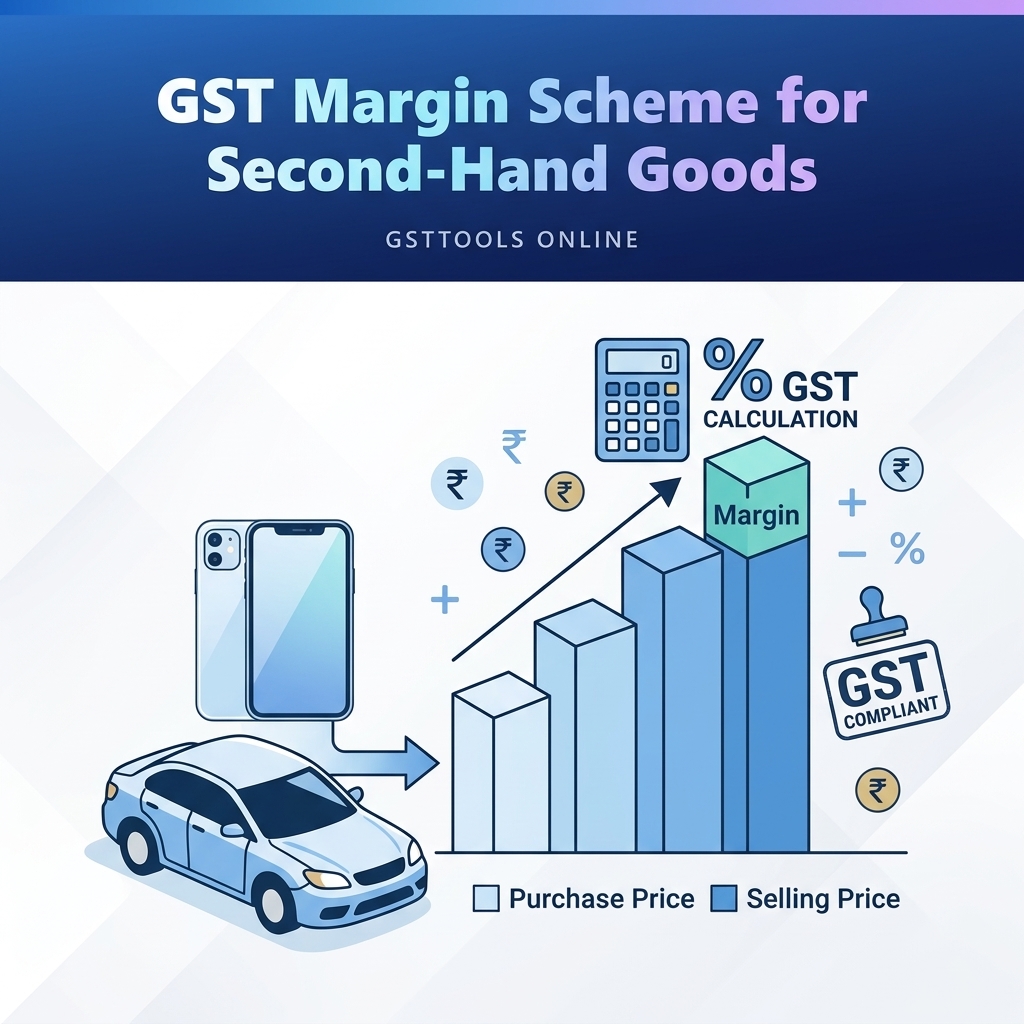
To rescue this sector, the government introduced the GST Margin Scheme under Rule 32(5) of the CGST Rules. This powerful provision allows dealers of second-hand goods to pay tax only on the profit margin they make, rather than on the total transaction value.
In this comprehensive, 1500-word guide, we will break down exactly how the Margin Scheme works, who is eligible, the strict conditions you must follow, and how to accurately calculate your liability using our specialized tools.
What is the GST Margin Scheme?
The core principle of the Margin Scheme is simple: Tax the value added, not the gross value.
Normally, GST is calculated on the transaction value of a supply. Under the Margin Scheme (Rule 32(5)), the value of supply is defined as the difference between the selling price and the purchase price.
- If the difference is positive (a profit), GST is calculated on that margin.
- If the difference is negative (a loss), the margin is ignored, and the GST liability is Zero.
A Practical Example
Let’s revisit the used car dealer.
- Purchase Price (from unregistered person): ₹5,00,000
- Selling Price: ₹5,50,000
- Profit Margin: ₹50,000
- GST Rate: 18%
Under the Margin Scheme, the dealer pays 18% GST only on the ₹50,000 margin. Tax Liability = ₹9,000. This is a viable, sustainable business model compared to the crushing ₹99,000 tax under standard rules.
To make these calculations instant and foolproof for your daily billing, always use our dedicated GST Margin Scheme Calculator.
Eligibility: Who Can Use the Margin Scheme?
The Margin Scheme is incredibly beneficial, but it is not a free-for-all. The government has placed strict guardrails to prevent abuse. To utilize the scheme, a taxpayer must satisfy ALL of the following conditions:
1. You Must Be a “Dealer in Second-Hand Goods”
The scheme is available only to a registered person who deals in buying and selling second-hand goods. An IT company selling its old office laptops cannot use the Margin Scheme; they must charge GST on the transaction value. The scheme is for businesses whose core trade is pre-owned items.
2. The Goods Must Remain “As Is”
The goods must be sold either “as such” or after minor processing that does not change the nature of the goods.
- Allowed: Buying a used car, polishing it, changing the oil, fixing a dent, and selling it. It remains a car.
- Not Allowed: Buying used gold jewelry, melting it down, and forging a new gold coin. The nature of the goods has changed, and the Margin Scheme cannot be applied.
3. No Input Tax Credit (ITC) Availed on the Purchase
This is the most critical condition. You cannot claim ITC on the purchase of the second-hand goods if you want to use the Margin Scheme. Generally, second-hand dealers buy from unregistered individuals (consumers), so there is no GST on the purchase anyway. However, if you buy from a registered business that charges you GST, you must make a choice:
- Claim the ITC, and pay output GST on the full gross sale value.
- Do NOT claim the ITC, and pay output GST only on the margin.
The Curious Case of Refurbishing Expenses
One of the most common points of litigation and confusion in the second-hand industry is how to treat repair and refurbishing expenses.
If you buy a used laptop for ₹10,000, spend ₹2,000 on a new battery and screen (from a registered vendor who charges GST), and sell it for ₹15,000. What is your margin? What happens to the ITC on the ₹2,000 parts?
The Legal Position:
- Your purchase price of the second-hand good remains ₹10,000.
- Your selling price is ₹15,000.
- Your margin, for the purpose of Rule 32(5), is ₹5,000. You must pay output GST on this ₹5,000.
- What about the parts? You can claim the Input Tax Credit (ITC) on the ₹2,000 spent on repair parts and services. The restriction in Rule 32(5) says you cannot claim ITC “on the purchase of such second-hand goods.” It does not restrict ITC on the ancillary repair expenses incurred to make the goods saleable.
This nuance is highly audited by the department, so your accounting must clearly demarcate the purchase of the core asset versus the purchase of repair consumables.
Special Rules for Repossessed Goods (Banks & NBFCs)
The Margin Scheme has a special carve-out for banks, non-banking financial companies (NBFCs), and financial institutions that repossess goods (like cars or machinery) from defaulting borrowers.
When a bank repossesses and auctions a vehicle, they are legally considered to be selling second-hand goods. How do they calculate the purchase price when they didn’t “buy” it, but rather seized it?
The rules provide a specific depreciation formula: The purchase price for the defaulting borrower is reduced by 5% for every quarter or part thereof, calculated from the date of the original purchase to the date of disposal by the bank.
If the auctioned price is higher than this depreciated value, the bank pays GST on the positive margin. If it is lower, the margin is zero, and no GST is payable.
Invoicing and Compliance Requirements
Operating under the Margin Scheme requires meticulous documentation. If a GST officer audits your premises, you must be able to prove the exact purchase price and selling price for every single unit.
1. Maintenance of Stock Registers
Unlike retail stores that can maintain batch-level inventory, second-hand dealers (especially in cars, electronics, and watches) must maintain a unique identification ledger. Every item must have a serial number, IMEI, or Chassis number linking the inbound purchase invoice/receipt to the outbound sale invoice.
2. The Sales Invoice Format
When you issue a tax invoice to your buyer under the Margin Scheme, there is a very specific peculiarity: You cannot show the GST amount separately on the invoice.
If you show the GST separately, the buyer (if they are a registered business) might try to claim it as ITC. But the entire premise of the Margin Scheme is that the chain of credit is broken. Your invoice must state the total inclusive price and contain a clear declaration: “This invoice is issued under the provisions of Rule 32(5) of the CGST Rules. No Input Tax Credit can be availed on this invoice.”
Conclusion
The GST Margin Scheme is the lifeline of the second-hand goods industry in India. Without it, the compounding tax effect would force the entire sector into the unorganized, cash-only black market.
By allowing dealers to pay tax solely on their value addition, the government has created a win-win scenario that promotes the circular economy and environmental sustainability.
However, the benefits of the scheme are contingent upon rigorous compliance. Ensuring that goods are sold “as is”, permanently forfeiting ITC on the core asset purchases, and maintaining serialized stock registers are non-negotiable requirements.
For daily operations, eliminate manual math errors by empowering your billing staff with our free GST Margin Scheme Calculator, ensuring that your tax liabilities are calculated flawlessly on every transaction.